Getting better at problem solving or solving better problems?

In my previous life I was an engineer for a leading premium car manufacturer. As a project manager I was responsible for building and testing engines before they went into production and onto the market. Clearly, what matters here is time and quality and, in striving to achieve them, I did typical (traditional) things – deriving project plans, holding status meetings, writing reports and agreeing milestones.

Despite best efforts, performance traffic lights were continuously amber or red. We threw more resources at the problem like implementing new IT or introducing new specialist roles.There was an armada of people supporting the process, keeping engineers occupied with form-filling and attending workshops. In the end, I’m not sure who was actually supporting who. Without any evidential data about what really worked, it felt like the focus of the whole organisation was consumed by such activity, rather than actually designing a cylinder head or testing an engine on a test bench (…which probably would have speeded up the process).

The problem with problem solving

From a traditional management perspective, I was doing a pretty good job. Now, from my new perspective, I can see that my thinking – which I believe was unintentionally designed throughout the whole company – was what I call a “sticking plaster” mentality. On reflection, I was tampering and using sticking plasters to achieve fixes, when I probably should have been calling an ambulance. We were good at fixing problems but not at solving the right ones.

Some say it is important to understand the root causes of problems, which sounds plausible enough. A variety of tools have been developed to help with this, such as the ‘5 Whys’, ‘Fishbone Diagrams’ and ‘A3-Problem Solving’. However, the reality is they have unintended consequences of their own: Give people a tool or a form to fill in and that becomes the focus of their attention. It’s suddenly all about the tool, rather than the problem; all about the process, rather than the thinking and, in particular, the most challenging question ‘Are we solving the right problem?’

Challenging conventional norms and thinking

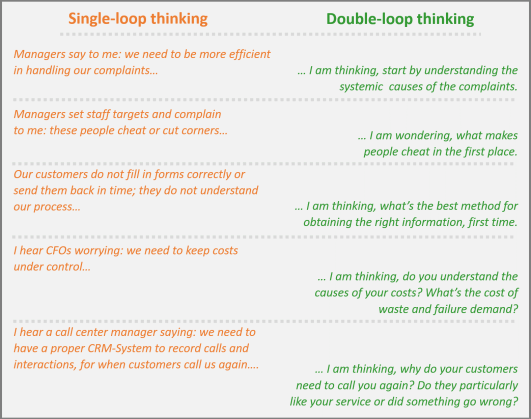
The only thing that really needs fixing is management thinking. If we do not challenge and change the way we think about problem solving, we end up with broadly the same actions and outcomes every time. Argyris describes this phenomenon as single loop versus double loop learning.[1] If organisations do not challenge their fundamental norms and assumptions, they end up tampering or sticking temporary plasters on problems. At best, they end up doing the wrong thing righter, possibly faster and at worst, wronger (single loop learning), instead of doing the right thing (double loop learning).

History is punctuated with great double loop achievements: the fight against cholera in the 19th century is one of them. In London in 1854, doctors believed that cholera was an airborne disease. Therefore, their action strategies included keeping windows shut, using face masks and so on. Did it help? Certainly not. Nowadays, everyone knows that cholera is a waterborne disease but in 1854, society’s single loop assumptions and solutions led to the death of 14,000 people.

That was until a doctor by the name of John Snow, challenged this thinking by plotting all the cases of cholera on a map and talking to residents. He quickly learned that those infected had all been using the same public water pump in Broad Street. After disabling the pump by removing its handle, the epidemic soon retreated. John had challenged conventional assumptions by getting knowledge, by analysing the problem on the ground and talking to the people involved.

Relating this back to the context of the business world equates to managers spending time with production and service teams, talking with frontline staff and listening to what customers are saying. It may not be as attractive as flying around the globe, holding strategy meetings or scrutinising performance reports but it is more effective.

Interestingly, Snow first began questioning the ‘airborne’ assumption 5 years earlier in 1849 but it took all that time, and a tragedy, to enable society to change its thinking. Would the 5 Whys or a Fishbone have helped? Would they have challenged conventional beliefs and norms? Or would they have led to the deployment of more and better masks?

In business, I see single-loop, sticking plaster thinking all over the place:

In order to properly understand the problems in individual organisations, managers need to study their systems end-to-end from the customers’ perspective. Take the example of the CRM-System [2]. When call centre managers study their systems, they typically find that much of their demand (40 to 80 percent of it) is actually failure demand [3] – demand that is caused by a failure of the system to do something or do something right for a customer. Conventional management logic is: when customers call us again, the advisor (usually a different person to the original advisor) does not know what was agreed in the first call, therefore we need a CRM-System to capture detailed instructions and information.

However, if the majority of these calls represent failure demand, what value is there in devising elaborate ways of storing them at vast expense (a single loop solution)? CRM-Systems are big business and big bucks: purchasing the IT, setting up project management teams to track progress, training staff to use them (often reluctantly). All these amounts to solving the wrong problem. A better problem to solve is to understand and remove the conditions in the system that prevent advisors from responding to value demands at the first point of contact.

Effective problem solving needs an inquiring mind, not a tool: getting knowledge by studying the system end-to-end from the customers’ point of view. Ultimately, challenging our assumptions about the problems we think we have, and their solutions, is more effective and less painful than ripping off the plaster.

Best of luck solving better problems…

By Hendrik Ascheberg

Further relevant resources:

BETTER DIGITAL FROM BETTER METHOD: upcoming event, London 16th of May 2018

If you are engaged in creating digital solutions into service organisation, this event will help you to step back and think of the problem you are trying to solve, before you spend further millions on IT and Digital:

Learn more

BEYOND COMMAND AND CONTROL NETWORK: The new network group across UK, Europe, OZ and South Africa

If you want to meet like minded people who are challenging command and control thinking in organisation, please get in touch and sign-up for free. I am responsible for the London and South-East area within UK as well as Germany. So if you are interested and live close, please get in touch with myself.

Learn more

Is NPS the right measure to improve customer service?

One of my new articles; learn more about failure demand as a measure to increase customer service and NPS

Learn more

The Vanguard Method in Financial Services:

Learn more about achievement of organisations who went beyond command and control by using the Vanguard Method:

Learn more

[1] Chris Argyris, Double Loop Learning in organizations, Harvard Business Review No. 77502, 1977

[2] CRM-System: Customer Relation Management system. Usually an IT-System, that documents customer related information.

[3] Vgl. John Seddon, Freedom from Command and Control

Failure demand: what’s the big secret?

By Simon Caulkin, award-winning business journalist.

Failure demand is a key concept for anyone running services. That only a minority of managers have ever heard of it speaks volumes for the state of management practice. Yet for those in the know it is a huge untapped reservoir of free improvement.

Failure demand is a defining symptom of the industrial-age but still dominant management paradigm we call command and control. C&C (for short) for many people summons up an image of commanders barking orders and demanding obedience from underlings. In fact, the key element is control. It results from the attempt to manage backwards from the desired outcome, which is a form of central planning, and like all central planning involves instruction from above and an apparatus of plans, targets, incentives and standards to channel effort towards the intended result. The hallmarks of C&C organisation, so common that no one even queries it, are management remote from the work, and work fragmented between front and back offices and by functional activity. It has been likened to driving using a rear-view mirror.

The better alternative – ‘Beyond C&C’ – is to think of the organisation and its customers as a system and manage forwards, not backwards. Demand and its nature is the starting point. The customer is boss, not the manager. This is not hard to understand in principle – but not by those trying to drive using a rear-view mirror.

It helps to know how the idea of failure demand originated. In the 1980s, Vanguard’s John Seddon was working with DEC Direct, a now defunct computer manufacturer that had the novel idea of selling computers by phone. To boost sales, the DEC chief wanted to introduce incentives. As a psychologist, Seddon reckoned that incentives would have perverse consequences (oh yes). Instead he proposed finding out what callers actually wanted. Investigating, the answer was clear enough: they wanted solutions to multiple problems with existing orders – documentation, billing, missing parts. Which led to the thought that if these unwanted calls could be eliminated, there would be more time (capacity) for agents to do what they were supposed to do – sell.

At first the offending calls were simply referred to as ‘calls we don’t want’. But it soon became evident that they were persistent and systemic – created by the system – qualities reflected in the name Vanguard finally settled on, failure demand, as opposed to the calls the organisation did want, the ones it existed to serve, which it called value demand. Failure demand is defined as ‘a demand caused by a failure to do something or to do something right for the customer’. Failure to do something – turn up, call back, deliver something – causes the customer to make another demand on the system. A failure to do something right – not solve a problem, send out wrong or incomprehensible forms, turn up at the wrong time – similarly generates knock-on demand and extra work.

Failure demand was a critical discovery. As it understood more, Vanguard came to see it as the smoking gun that proved a) that the C&C paradigm that enabled traditional mass-production didn’t work for services, and b) why. The reason is not hard to seek. The model behind the mass-production mindset of the 20th century is Adam Smith’s pin factory, based on standardisation and specialisation to achieve economies of scale and drive down unit costs. But customer service, let alone medical treatment, social care or benefits, can’t be made in a factory with standard times and procedures. Since it is unable to absorb the variety of human demand, it condemns those who are ill-served to come back until their problem is resolved. By manufacturing failure demand, this kind of service is self-defeating.

Once this is recognised a number of seeming paradoxes are suddenly explicable. Failure demand explains why conventional cost-control methods don’t lower overall cost; why efficiency and productivity measures aimed at regulating apparently rising demand (outsourcing, for example) do the opposite; and why high cost and low quality are as inseparable as the reverse. It explains how organisations can be simultaneously frantically busy and highly ineffective.

Does that remind you of anything? It should.

The bad news is that failure demand is shockingly prevalent, everywhere. Among the worst offenders are banks, financial services and telecoms in the private sector, where ‘calls we don’t want’ can be as much as 80 per cent of the total. The ratio is similar in parts of the NHS that Vanguard has studied, and probably the rest of it too. In other public services, such as the police and local authorities, 50-60 per cent is common. Even organisations that pride themselves on reaching all their service targets are dismayed to discover that up to half of their resource is being consumed by non-value work.

Let’s spell out some of the implications.

The NHS, for example. The reason the NHS is in permanent crisis is not inexorably rising demand, as the headlines would have us believe. Instead it is choking on self-created failure demand that causes patients to present and represent multiple times for the same issue. What’s more, the most intensive consumers of resource often aren’t the most ill but those that the service is least able to help: frail elderly stroke or accident victims who are kept alive at the cost of increasing indignity, pain and distress to themselves and their relatives, or those presenting over and over for drug- or alcohol-related issues whose underlying problems are not medical but chaotic lives – and the latter group is consuming more resource than the former, contrary to what we are told. Other public services are in the same boat: they do have a resource problem, but it’s one of deployment rather than quantity, as usually supposed. As just one contentious example, take housing, where demand for local authority properties is inflated by lists that are full of applicants who are dead, have moved away, are on all the lists in the region or are obviously ineligible, and cumbersome letting processes that encourage applicants to apply for every property available, however unsuitable, in the hope that once accepted they will be able to swap it for something more appropriate.

Private-sector customer service organisations are similarly dysfunctional. Because of their industrial design they don’t consider customers in the round or themselves as systems, with the result that they don’t perceive the double counting. All they can see is greater numbers of people clamouring at the door, which ironically they often attribute to growing value demand. One result is that many service organisations have no idea what underlying real demand is, nor their capacity to deal with it.

But there is another side of the ledger. Being self-created, failure demand is under the organisation’s control. The good news is that for aware management failure demand represents enormous unlooked for potential for improvement. Eliminating or at least reducing it provides a double hit. It cuts the cost of service by reducing rework and duplication. But at the same time – the big secret – it also frees up capacity to deal with the value demand, which now has much greater visibility.

Just how large the gain will be can never be accurately predicted in advance. But it is likely to be far greater than anyone would dare to put in a plan – as the two examples below make clear.

  • A large insurance company was planning to bring back its customer-service operation to the UK from India to improve ‘customer retention’. Instead of simply recreating the outsourced operation in the UK the leader was helped to analyse demand, which she found to be running at 70 per cent failure and just 30 per cent value demand. Further study showed that the primary cause of failure demand was detailed contract specifications that left agents no flexibility to respond to the variety of customer calls. In some cases it took up to 17 transactions to resolve a single case, with an average of 2.5. In response the work was redesigned with aim of making each transaction ‘clean’ so that a case could be settled in a single pass, with agents equipped to handle all predictable causes of demand and expertise on hand for the others. Two years on, the UK service centre was handling all the repatriated calls with 300 agents instead of the previous 700. C&C methods are now being replaced by systems thinking throughout the company.
  • In another insurance business, part of a large UK bank, the leader of a home claims operation was in charge of 35 ‘change projects’ aimed at combating rising costs and weak Net-Promoter scores. Much of her job was checking KPIs and ‘deliverables’ on the projects, while keeping operational ‘traffic light’ measures showing ‘green’. When she started studying the service as a system, however, she was shocked to find that none of this activity management was helping distressed customers get back to normal – worse, nor were her change projects. When senior managers were similarly sent out to study, they quickly agreed to cancel half the projects on the spot and for the first time saw the claims process through the customer’s eyes. As a result, failure demand shrivelled, claims were settled in days rather than weeks, and customer satisfaction shot up. Soaring morale in a front line which loved being able to help customers was an added bonus; more surprisingly, as trust between insurer and insured increased, indemnity costs fell by one third. After getting over the shock of discovering that their own work was the cause of the systemic failure demand (failure demand squared, as it were), managers too enjoyed their new role of making it easier for people to do their jobs.

As Peter Drucker once put it, ‘There is surely nothing quite so useless as doing with great efficiency what should not be done at all.’ To access the huge untapped reservoir of free improvement simply requires leaders to understand that failure demand is systemic, that it is a signal of ineffectiveness and that the only way to be rid of it is to change the system, change their theories of control, design effective services and, thus, go beyond command and control.


Is Net Promoter Score the right measure to improve customer service?

The Net Promoter Score (NPS) was developed in the early 2000s by Reichheld and Markey who were working for an American consultancy (Bain and Co). At that time, the problem they thought they had to solve was how to boil down lengthy customer satisfaction surveys to one figure, the NPS. The question asked of a customer was ‘How likely are you to recommend us?’ This is indeed a really interesting question to ask, because it will give some insight into the happiness of customers and therefore the organisation’s reputation. NPS is now near ubiquitous throughout the public and private sectors. However, from my point of view, something crucial is being missed here: How would you go about improving your scores?

Obviously, NPS was not designed to help you to do that. I call NPS a lagging or consequential measure. A consequence of changing the service may become apparent if the NPS goes up, down or stays the same. In that way it might be helpful to track if changes you make show signs of an improved NPS. To me, it is a bit like staring at your weight on a set of scales when you want to lose a couple of pounds. That, in itself, that won´t help you to lose weight will it?

Now Reichheld and Markey suggest to ‘close the loop’ with a client, e.g. contacting the client immediately afterwards and solving the root cause of their problem. Solving the root cause is great, but my experience has shown that the root cause lies in management thinking about the way work is designed and managed. These are fundamental changes that require a concerted organisational effort.

Working with service organisations, they tend to go for conventional approaches to making a change: They might differentiate NPS in products or functions and prioritise. They might train people to be politer to ensure a better customer experience. They might define standard procedures for staff to follow to get a standard level of service quality. And beyond that they might set up quality teams to check if staff are working to these standards. They might build customer loyalty programmes or might send staff or management on training programmes to be more customer centric, etc, etc. To be honest though, in my view, this is doing the wrong thing righter and therefore a waste of time and money. It is designed around assumptions about how to improve NPS, not on proper knowledge and understanding of why the organisation is not performing. When I study service systems I hardly find unfriendly staff, but very often unhappy customers who have to contact organisations again and again to get their problem solved. Do we want to ensure that customers get served in a friendly manner to a standard? Or do we want to understand why customers have to get in touch with us multiple times in the first place?

There is a better, more systemic method to understand where it goes wrong and what needs to be changed: study the system from a customer’s point of view and establish better measures to learn and improve.

Definition of Failure Demand by John Seddon, Freedom from Command and Control (2003)

In any transactional service, the very first thing to study is the nature of the demand being placed on that service. There are two demand types: value demand and failure demand. Value demand is demand that an organisation wants – ‘Ì want to buy your product,’ ‘I need car insurance’, ‘Please fix my boiler’, and so on. Failure demand is demand that is caused by a failure to do something or do something right for the customer – ‘I am still waiting for my insurance policy’; ‘I don´t understand your form’, ‘I wanted a green one, you sent me a blue one’, etc.

So that includes all the times where customers need to contact you again, or maybe even at all, because your digital channel did not work or was not clear. If you understand type and frequency of failure demand and the cause, you can reduce it and improve customer experience. Consequently, NPS ratings usually go through the roof. Failure demand is therefore a measure that helps to learn and improve, which I call a leading measure. If you pay attention to these leading measures, the lagging measures like NPS will take care of themselves.

Now the icing on the cake: you will not only increase customer satisfaction, but you will also reduce costs. Vanguard studied service systems around the world and we experienced failure demand rates between 40 and 90 percent. In other words, the organisation wasted between 40 and 90 percent of their capacity with failure demand, demand that we do not want in the first place. Imagine what happens to costs when failure demand is reduced.

The opportunity to reduce costs and increase NPS, reputation and sales in the long run is massive. But it will take some rethinking of current management practice, some determination to study your own system before defining better measures that help you to learn and improve. So, let’s stop staring at our scales in the hope of magically losing weight!

Hendrik Ascheberg

Additional resources on Failure Demand and NPS

New article by Simon Caulkin: Failure demand: what’s the big secret?

New Vanguard Event: Better digital from better method, London 16th May 2018

Listen to Rob Brown talking about saving £100 million and improving Aviva’s NPS from -40 to +50.


2 minute interview with Dave Kerr, Lloyds Banking Group

Dave Kerr, Customer Journey Design Senior Manager, Lloyds Banking Group

Q: How would you summarise the impact of Digital on financial services?

A: It’s changed everything; the expectations of customers (both in terms of form and function), the pace at which providers need to respond to demand, simplicity as hygiene rather than a differentiaton. The face of financial services has irrevocably changed to put the customer at the heart of everything.

Q: What distinctions of the Vanguard Method positively impact delivering benefit?

A focus on meeting actual customer need rather than perceived customer need.

Q:  Why are you speaking at the ‘Better Digital from Better Method,’ conference on May 16th?

Lloyds Banking Group has learned a great deal on its digital transformation to date – some good, some bad, some ugly! – and we are keen to both share and inspire others to go on the same journey.

Meet Dave and find out more about Lloyds’ digital transformation in London at ‘Better Digital from Better Method,’ on 16th May. Limited places available.


Do shared services bake bread?

Last week I spent a day at a public-sector shared services conference in Manchester. The experience moved me to write… I hope it moves readers to do all they can to alert public-sector leaders, politicians and anyone who ought to care to what has been, and will continue to be, an ill-conceived folly – a shocking waste of public-sector funds.

As I expressed it in my title slide: Does sharing services ‘bake bread’? What does? More on what I had to say later.

The opening keynote was from the interim leader of the Government Shared Service programme (‘interim’ – there’s a clue); a very nice man. If I’d been playing Consultant-speak Bingo I’d have had a full house in no time. We heard:

We aim to be the best civil service in the world, we are already world class

Shared services is a lever for change

Shared services in government is no longer a ‘programme’ it is ‘strategic’

We are to be a centre of excellence

We are re-shaping our governance to be more inclusive and more strategic

Technology drives a different way of doing things

The wider changes in society mean greater expectations amongst the public

Implementation will be Agile

We are going to professionalise our people

We will drive value and efficiency

We will take advantage of off-shoring

We want more self-service

We will be using robotics and artificial intelligence

I’ll come to my misgivings about much of that when I get to what I had to say when it was my turn. Interim Leader described how this was going to be done: A decision has been made to split up the management of technology and management of the service centres as this, we were told, will drive lower costs. We heard about there being three technology platforms, there will also be ‘process convergence’; process standardisation will be ‘relentlessly’ driven and there will be ‘standardised functions across government’. The services will be ‘designed around user needs’ and will be ‘intuitive, easy to use and mobile’. Just as services will be digital, government will be ‘digital on the inside’. And everything will be done in a ‘collegiate and collaborative’ way, establishing a ‘cohesive community of practice’.

What’s your level of confidence? Would you invest?

Well, actually, you are investing.

Interim Leader assured us they had already saved 20% of their operating costs. This was a surprise to me. The most recent National Audit Office (NAO) report said the savings were less than the costs. I asked Cabinet Office attendees, they told me this 20% was the discount on current operating costs that is the basis for the contract with the private-sector provider. So that’s a promise. And we know from the NAO that there are hundreds of ‘change orders’ in the mix – these are the means by which providers can get more money from their entrapped clients; ‘oh, that’s beyond the contract’… I remember being told by an IT consultant that IT contracts ensured the client got ‘breakfast lunch and dinner’… but ask for anything else and the charges can make your pips squeak. I also learned that the Cabinet Office has a benchmarking cost-of-transaction activity. If you are a regular reader you will know that the cost of transactions tells you nothing about the cost of a service.

So there I sat, feeling very animated, even furious. Perhaps I shouldn’t have been surprised after all this is nothing new. But that’s my point; given the exorbitant cost of well-publicised failures of shared services shouldn’t we be just a tad more cautious?

The NAO has published plenty on the costs of failure and their representative was up next. Interim Leader had been generous in his praise of the NAO, even though the reports were critical, and the compliment was returned; NAO Representative declared himself to be ‘supportive’ of Interim Leader. Warm feelings were shared. I didn’t feel so cosy.

NAO Representative would have ticked further boxes on my Bingo card. He told us that shared services should be seen in conjunction with ‘transformation’. By this he meant the quality of business cases – they should be ‘realistic’, represent ‘value for money’ have ‘clarity’ and show understanding of ‘risks’. I’m sat there thinking this juggernaut is one humungous fat risk. Business cases are dreams.

Transformation also means ‘leadership’, ‘governance’, ‘operational planning’, data quality and so on – my mind wandered before I could copy the rest down and the slides moved on… Apparently there has been too much turnover of leaders. I turned to see how Interim Leader reacted to that. It came to mind that the blessed Universal Credit fiasco has churned leaders, some sacked, some resigned, some sick. Who’d want the job? Why did Interim Leader look so relaxed, confident and kindly?

NAO Representative showed us a slide extolling anticipated savings, more promises; no doubt the numbers taken from business plans. He joined Interim Leader’s theme in discussing the pros and cons of seeking collaboration versus mandating involvement. You may recall Frances Maude, previous Minister for the Cabinet Office, insisting, through frustration, on mandating. After all, the plans demand high volumes of work moving to shared services.

Despite the series of NAO publications evidencing the expensive failures of shared services we had no explanation other than his general remarks on what’s important in ‘transformation’. Was this what was missing? How confident can we be? Is this trying harder? Is it doing the wrong thing righter?

My mind wandered back to a meeting at the NAO a few years ago when the failures first hit the news. I had always regarded the NAO as an important independent voice; I was invited and was pleased to attend. The purpose was to discuss the reasons for failure. I told the meeting the things I told this conference (see later); and in much more detail as we had a whole day to discuss. But nothing of what I’d said got into the report of the meeting. Every other participant came from IT and major consultancy firms. And they, like NAO Representative on this day, thought it merely a matter of doing it right.

A quick search on the internet revealed NAO Representative used to work for McKinsey, I knew already his boss used to work for PWC. Forgive me for speculating that the NAO, like many government departments, has been hijacked by the Big Consultancies.

Next up was IT Man. More boxes to be ticked on the Bingo card. Digital and Artificial Intelligence (AI) are, he proclaimed, ‘disruptive’ technologies. ‘You don’t want to go the way of Blockbuster’ (yawn, how often has that been cited as the ‘killer’ case?). ‘It’s a mobile / social media world out there now’; ‘the technology is coming to the office’; ‘traditional organisations are ‘edging towards digital’, the two ‘operating models’ will meet, ‘AI will connect them’. It’s all about doing things in an ‘Agile’ way.

And he banged the same drum that is the basic rationale: transactions will be cheaper; we will save enormous sums of money. Oh really?

When my turn came I put up a slide with the politicians’ view of shared services. A report from the Public Accounts Select Committee had this to say:

“Central government has long pursued shared service centres as a way to reduce costs and free up resources from back-office functions to provide better front-line services. The principles of reducing costs through using shared services are straightforward and widely understood, combining two key elements: one element is to standardise processes and services so that they can be provided in a consistent and repeatable way, in high volumes, by a single provider on a common operating platform; the other element is to outsource operations to an organisation that can specialise in providing a service and, through economies of scale, can offer the service at a lower cost.”

This is the gist of what I had to say:

These are politicians. What can we expect them to know about management? How did they come to this view? By listening to advisers; and amongst those were the IT and Big consultancies – in the early days there was an all-party group on shared services, serviced by the National Outsourcing Association whose members were… yes, you guessed.

Rather than being ‘straightforward and widely understood’ it would be more accurate to say the idea is plausible and widely embraced.

Rather than having ‘two elements’ as described above, there are four basic arguments. The first is ‘a common operating platform’; a euphemism for a large-scale IT system. What politicians ought to know is that 90% of large-scale IT systems fail. 30% fail completely (e.g. Single Farm Payment, NHS patient records and others) 60% fail in as much as they cost much more than planned, are not fit for purpose and don’t deliver the planned savings; lots of those.

The second is standardisation. Standardising service work drives costs up. Simply because a defining feature of many service organisations is the variety of customer demand. If you push high-variety demand into standardised processes you drive costs up.

The third: economies of scale. There are two arguments for savings from economies of scale in service organisations: less of a common resource and lower transaction costs. Less of a common resource, which means fewer managers, IT systems, buildings and so on, is a sound argument, but not always easy to achieve. For example sometimes it is hard to dispose of buildings or existing IT contracts; an argument that purchasing one IT system between three organisations that are sharing saves the cost of two is hardly an argument for savings and, in any event, was an IT system necessary? Regardless, any saving from less of a common resource is relatively trivial. Trivial though it is, it is the only real evidence the protagonists can cite. The much larger savings are promised to come from lower transaction costs; this is always the dominant argument in the business plans. But, as regular readers will know, if you focus on cost your costs go up.

And the fourth argument is that services should be outsourced to specialist organisations. When we do that we lock in cost escalation.

I asked how politicians react to the abundant evidence of failure. Admittedly they’d be unaware of failures in the private-sector, and there have been many. But public-sector failures have been in the news regularly. Think Cornwall, Somerset, Sandwell, Liverpool, Rotherham, Birmingham, Suffolk, Account NI, Research Councils, Centralised police call-handling in Scotland among many others. And news of the same in Australia, New Zealand and Canada where governments have imagined the UK government knows what it’s doing. And the only reaction I have witnessed is the same as we heard from Interim Leader and NAO Representative: it’s OK if you do it right, so let’s improve the governance and project management.

I said there are three types of shared services out there: those with true but minor savings from less of a common resource (e.g. local authorities), those with no knowledge of savings as there was no original cost baseline and which, if you talk to the users, don’t work too well and those that have failed or are in the process of failing; the categories not being mutually exclusive. So why do they fail?

The simple answer is they are classic command-and-control designs. To illustrate what’s gone wrong I told the story of a private-sector client that had, when we first met, had outsourced its service work to India. I named the client – a household name – and I shall name them in my next book. Essentially the story was they had decided to repatriate the work to the UK. They had 500 people working in India and 200 in the UK. They had a plan. Quite naturally the plan was to hire 500 people in the UK to take this returning work.

We suggested they put the plan away and instead get out and study what was going on. They had a classic industrial design, exactly the same as we see in shared services: front-office / back-office, SLAs, standard times, activity management, specialisation, standardisation and so on. These systems create enormous amounts of what I call failure demand. Seeing that for themselves energises leaders. At first they think the causes are people not doing as they should and/or processes not properly designed, but they learn through studying that the causes are everything that they think of as good management (the features above); failure demand is systemic, a natural consequence of an industrial design, and it starts to dawn on the leaders that their obsession with managing cost is actually creating costs. And that’s the big problem with shared services, they are industrial designs.

I outlined the better design that the leaders put in place. Thorough knowledge of customer demand dictated the expertise required to give customers what customers needed. No longer were service agents constrained by activity management instead the measures of performance were defined in customer terms; I describe this as designing against demand. It is to focus on effectiveness not efficiency. The result was all work was returned to the UK, the quality of customer service jumped and it only required 300 people. Who, I asked, would have put that number in a plan? Designing for effectiveness drives costs out of a service by increasing capacity; failure demand drops rapidly.

It is the central point. Improvements of this magnitude have been evidenced in the public sector too, and they are the result of changing the way we think about management. The shared services strategy reinforces everything that is dysfunctional about our current style of management. Think back to the Blair target for every local authority to have a call centre. When they obliged, they all discovered they had more demand than they had anticipated in the plan, just as had occurred in the private sector; the design was creating failure demand. It was chasing efficiency – lower transaction costs – the wrong thing to focus on.

I gave examples of the enormous savings local authorities have achieved by studying and using that knowledge to design for effectiveness. In people-centred services many lives are quickly back on the rails, services are vastly improved, costs fall dramatically. I pointed out that if they’d shared their service (e.g. share a call centre, share a building in the name of ‘integration’) they’d have got nothing of the kind but would only have cemented in conventional command-and-control management practices – the very things that had been revealed as dysfunctional when studying.

I talked about the housing association I mentioned in my December newsletter that had dumped a half-million-pound IT system, which was two years into implementation, when they studied and redesigned their repairs service. Following study and redesign, and having a design that drove costs away, they knew what they needed from IT and built it for £40,000. My point was simple: IT is the last thing to do, not the first.

These examples, I didn’t have time for more, show the scope for genuine improvement of public services and they operate at costs that are so much lower than anything that would have been put in a plan.

Finally I gave advice: If you are thinking about sharing services, don’t. Instead do as these examples did, study the services as systems, redesign them and if you need IT make it the last thing you do. Following this path will result in the big prize, far better services and much lower costs. If, subsequently, you choose to share these services you’ll also gain the much smaller saving from less of a common resource.

If you’ve already shared services, don’t worry, they can be redesigned wherever they are, and you will need the leaders to understand how to study and design; if they don’t lead it, it will never fly. A simple first step is to study how much failure demand there is, it will tell you how ineffective the services are and this should energise leaders to do something constructive about it.

If you’ve outsourced services to a private sector shared service then, probably, you’re already stuffed. Failure demand represents greater revenues for the private-sector provider as contracts are usually based on transaction volumes. Nevertheless insist that the provider joins you in studying the extent of failure demand and test their appetite for redesigning the services. Be open about the need to change the contract once a more effective design is developed. Going through the process will expose the attitude of the provider; are they a true ‘partner’? Be aware that getting out of the contract might cost a lot, as it has done for others.

When the shared services initiative started five years ago we were told it was going to save £2 to £4 million a year. We haven’t seen anything to match the promise; instead we are overwhelmed with evidence of failure. As time has gone on the promises become less ambitious. By contrast there is abundant evidence that public services can be massively improved while at the same time radically reducing costs and it can be done in months, not years.

While the shared services protagonists claim services will be designed around user needs – and often, would you believe, they use personas (imaginary people) and focus groups to do this – to design around user needs requires first of all thorough knowledge of citizen’s demands.

Shared services are IT-dominated. IT should be the last thing you do, not the first. Doing ‘Agile’ IT is merely doing the wrong thing faster. To separate technology management from operations management is a mistake. Technologists should be directly connected and subordinate to operations design. The techies like that, after all they think it’s cool to do stuff that works. You spend less and get more.

Demand is the big lever. Sharing services isn’t. You don’t need a business case or a plan. To improve services you have to study them – get knowledge – and then design them to be effective. Cast your mind over examples of ineffectiveness and ask yourself: if this had worked immediately for the user would it have been more efficient?

I encourage you to share this report with anyone who ought to care.

John Seddon


Join the Beyond Command & Control Network

We, humankind, invented management, we can change it.

Do you know in your bones that Command-and-Control management has had its day? Are you actively interested in moving beyond the cost-increasing, revenue-jeopardising, morale-bashing Command-and-Control ideology? Or perhaps you are aware that pioneers have achieved levels of improvement – both in the numbers and morale – that are nothing short of jaw-dropping?

A national network

Then join with others in the Beyond Command and Control Network.

Signing up for the network is free. Connect with fellow travellers at national events. Receive a regular newsletter to find out what’s going on in the Beyond Command and Control movement.

Get first notification of the Beyond Command and Control Masterclass series and a member’s discount on the ticket price. The Masterclass series will expose you to the profound achievements of the pioneers, equip you with the practical means and help you understand the issues on the Beyond Command-and-Control journey.

Local and practice-based networks

We know people find it valuable to share their journey and learning with others. In order to help you do this, we plan to support a range of local and profession/practice-based networks across the UK in 2018 in response to demand.

If you are interested in joining or setting up a local network where you live or a practice-based network for your profession, please tell us what would best help you on the form below.

Sign up FREE

Join a network of people moving beyond command and control.

All we want from you is enthusiasm, an interest in being on the journey and a willingness to share your stories.

Whether you are interested in joining a local network or would just like an occasional email from us, sign up here:

← Back

Thank you for your response. ✨