The Vanguard Method in youth protection wins award

Youth Protection Region Amsterdam (Jeugdbescherming Regio Amsterdam), working with Vanguard Netherlands, won ‘The best public sector organisation of the year 2014’.

The jury said:

“Youth Protection Region Amsterdam has made a profound change in its methods and culture with a lot of guts and passion. Passion, pride and professionalism in this organization is nicely connected.

This has led to a dramatic performance improvement and a big increase in well-being and professional pride of the staff. In a system that is grim, gripping and tough. The success achieved by contemporary mobilization of ‘bottom-up learning from the professionals.

The organization has become substantially cheaper and the quality of its performance has improved tremendously.”

Results summary:

60% reduction in ‘out of home’ placements, 50% less protective measures are now needed, 45% less probation measures are required and referrals to the service have fallen by 28%.   Staff sickness has also reduced by 26%.

Further information:

On 27th January 2015, the annual Government Awards 2014 took place in the Hall of Knights in The Hague.

100 applications were received, 10 organisations were shortlisted, and 4 finalists were visited by the jury.  The jury judged the award on the following criteria:

  • mission enthusiasm,
  • effectiveness,
  • cost consciousness,
  • reliability,
  • expertise,
  • openness,
  • learning ability,
  • good employment,
  • resilience,
  • and community involvement.

With a population of 1.4 million residents in Amsterdam, Jeugbescherming Regio Amsterdam support 6000 families and over 12000 children with child and youth welfare, protection, and probation.


Jim Mather reviews ‘The Whitehall Effect’

The Whitehall Effect by John Seddon – review by Jim Mather for ‘What Works Scotland’

Jim mather review The Whitehall Effect book cover

Reading this book reminds us that John Seddon is a psychologist. He proves that his great contribution has been to take the Deming emphasis on quality, continuous improvement and the challenging of orthodoxies into the arena of services and meet the unique needs of real people with humanity, kindness and flexibility.

And by “real people”, I mean clients, staff, senior management and policy makers.

John highlights that helping people back to their most sustainable levels of self-reliance and in some cases getting their lives “back on the rails” is the kindest and most cost-effective public services strategy, as well as being the most fulfilling for our public service professionals.

He is also very helpful in establishing that any service or any policy intervention ought to have three components:

  1. The purpose – as defined by the legitimate and reasonable service user(s)
  2. The measure(s) that can convince those users that the “purpose” is being met.
  3. The method(s) that can be developed and used to deliver the measures and meet the purpose.

In stating that, he is adamant, that these three components work best when the policy-maker defines the purpose exclusively in terms that users would support and then stops. Leaving the people-who-do-the-work to decide on the measures and develop the methods that progressively produce better and better results.

He is equally adamant that targets in the context of purpose are toxic. They can become the de facto purpose of any service, encouraging people to game the system and cheat.

That single insight is worth the price of the book for it offers:

  • The politician the chance to genuinely lead and avoid being too prescriptive and wrong
  • The manager the chance to deliver meaningful local leadership, get better results and higher morale
  • Front line staff the chance of better results, more autonomy and more fulfilment
  • The user the chance of better, crisper services, increased self-sufficiency & self-respect

And of course, being a John Seddon book, he does not pull his punches. He exposes the weaknesses and damage caused by the mis-use of: Back offices, Call centres, Commissioning, Information Technology, Lean, Procurement, Policy-Making, Regulation, Risk Management, Shared Services, Specialisation, Standardisation, Targets, etc.

So, if you have any of the above in your environment, and especially if you have been directly involved, then you need to read this book because John offers us all a route to remedying even their worst manifestations.

But the final word on this book should be left to John. I wrote and told him recently about a facilitated reading of his book with a management team.

His advice was typically to the point and it also applies to the book, which is also not an “end in itself”.

He said: “… the most important outcome can only be to agree to go collectively to study a service somewhere. Of course the leaders of that service have to be part of the study team, otherwise a train crash will ensue… Maybe the best way to tackle this hurdle is to make the purpose of the workshop nothing more than a curiosity-builder, inviting the curious to take the next and vital step.”

This book is both a curiosity builder and a map that allows us to avoid pitfalls and plan a better, more collaborative and inclusive way forward – and it gets my enthusiastic endorsement.

Jim MatherJim Mather (pictured left) is a former Scottish Government minister who has maintained a lively interest in public sector reform, especially any move that increases the understanding and deployment of systems thinking and which recognises the criticality of aligning Scottish public services with the reasonable and legitimate interests of the people of Scotland.

What Works Scotland is a new initiative to improve the way local areas in Scotland use evidence to make decisions about public service development and reform. WWS brings together the Universities of Glasgow and Edinburgh, other academics across Scotland, with partners from across Scottish public services. www.whatworksscotland.ac.uk

Read the Foreword  of The Whitehall Effect by Lord Victor Adebowale in full.

Read an edited extract from The Whitehall Effect in the Guardian, 5th November 2014.

The hardback is available to order now from Triarchy press at £20.

Click here to see a video of Jim Mather (and other leaders) talking about the Vanguard Method

Archived News

Click below to see our archived News, the most recent stories are at the top of the page.

University of Buckingham
The Vanguard Method for People Centred Services


John Seddon speaks at University of Newcastle


The Whitehall Effect
The Vanguard Method in youth protection wins award


Jim Mather reviews The Whitehall Effect
Jim Mather reviews ‘The Whitehall Effect’


The Whitehall Effect
John Seddon’s best book yet: The Whitehall Effect


Vanguard and Locality: Saving money by doing the right thing
Report launch: Saving Money By Doing the Right Thing


Government Advisor backs Seddon's ideas
Government Advisor backs Seddon’s ideas


Kittens are Evil
Free summary of Kittens are Evil


back office
The back office: a train crash coming to a town near you


stoke kier logos2
Kier Stoke & Stoke-on-Trent City Council win prize


francis report logo
John Seddon on the Francis Report


Report Launch: Saving Money By Doing the Right Thing

Failure demand is the biggest cause of rising demand, not demographics, according to a new report, Saving money by doing the right thing: why ‘local by default’ must replace ‘diseconomies of scale’, published at a House of Lords launch on 12th March 2014. The study analysed hundreds of thousands of demands placed on the public and third sectors across multiple localities in the UK over the past three years.

Ministers, civil servants and public sector leaders learned that that more than £16bn of public money could be saved every year by tackling ‘failure demand’; unnecessary demand such as repeat assessments, multiple referrals, delayed discharge, unwanted equipment and unsuitable services, all demand caused by a failure of public services to understand people and provide them with what they need.

The study, published by Vanguard and Locality is the first of its kind to discriminate between artificial demand for public services, generated solely as a result of an organisation not taking the right action and real demand, experienced by the person who needs help.

“Everyone thinks the rise in demand for public services is caused by an ageing population and a rise in long term chronic conditions. But is there another explanation? We tend to think that the rise in demand is coming from new people, it is not, it’s the same people. Studies of hundreds of thousands of patient records, case notes and files reveal that the main cause of rising demand is the same people fighting the system to get what they need. Public services assess the same people up to a hundred times, refer them on multiple times, keep them in hospital when they shouldn’t be there and give them equipment they can’t use. All this unnecessary activity isn’t free. This finding marks a seminal moment in our understanding of demand for public services because it shows us exactly what to do. We should design services which are able to do the right thing for people in the first place”.
John Seddon, Vanguard Consulting

The report outlines the two main causes of failure demand, discovered empirically in the studies. The first is the prevailing belief held by the Treasury in ‘economies of scale’ and the second is the drive from procurement professionals and IT companies to standardise services.

This is the first major challenge to the widely held belief that economies will come from buying in bulk and reducing unit costs. The report argues that too many services prescribe standard packages of activity rather than understand what improves a life. This in turn causes huge amounts of failure demand and spiralling costs because people get what they are given, not what they need.

“We know how to reduce billions of pounds worth of unnecessary demand on public services; simply abandon scale in favour of designing localised services which are able to do the right thing for people in the first place. It is not public service which is at fault here. It is a system dominated by scale and standardisation. That is what needs to change” Steve Wyler, CEO Locality

John Seddon’s best book yet ‘The Whitehall Effect’

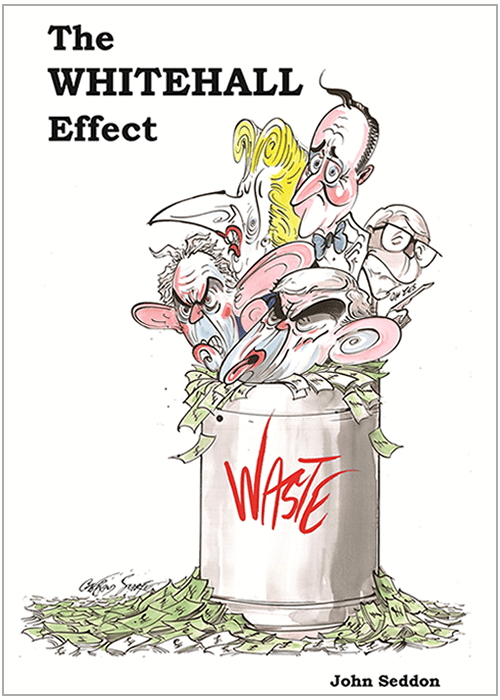
The Whitehall EffectIn The WHITEHALL Effect, John Seddon explains how successive governments have failed to deliver what our public services need and exposes the devastation that three decades of political fads, fashions and bad theory have caused. With specific examples and new evidence, he chronicles how the Whitehall ideas machine has failed on a monumental scale – and the impact that this has had on public sector workers and those of us who use public sector services.

The Whitehall Effect exposes a bureaucracy that is institutionally resistant to new ways of doing things, perpetuating a system that is both profligate and inefficient…Those who have listened to [John Seddon] have transformed the way things are done, cutting costs and waste while ensuring services are delivered effectively…”
Phillip Johnston, Daily Telegraph, 4th November 2014

“John Seddon’s forensic eye is sobering and brings clarity and some sense of empowerment for those like myself who believe passionately in delivering better services to the public”.
Lord Victor Adebowale CBE

Read the Foreword by Lord Victor Adebowale in full.

Read an edited extract from ‘The Whitehall Effect’ in the Guardian, 5th November 2014.

The hardback is available to order now from Triarchy press at £20.

The Whitehall Effect

John Seddon is back. This time with an uncompromising account of Whitehall’s effect on our public services. It’s a damning read and may cause some serious fireworks.

Published 5th November 2014 from Triarchy Press.

In The WHITEHALL Effect, John Seddon explains how successive governments have failed to deliver what our public services need and exposes the devastation that three decades of political fads, fashions and bad theory have caused. With specific examples and new evidence, he chronicles how the Whitehall ideas machine has failed on a monumental scale – and the impact that this has had on public sector workers and those of us who use public sector services.

The WHITEHALL Effect provides fresh insights into some of the most challenging issues of our time (because of their impact on health, education, policing and all public services) and reveals the unprecedented opportunity we now have to create the public services we all deserve.

Required Reading…
“We need a new paradigm that puts the citizen/customer first, drives value into the lives of recipients and costs less… This is the challenge behind what needs to be our 21st-century vision for services-to-the-public. The Whitehall Effect sets out the way we might deliver better services. It should be required reading for anyone who delivers a service to the public.”

The Foreword is written by Lord Victor Adebowale.  You can read the Foreword in full here.